The number is not asserted. It is the length of a registry in the product repository where every entry names a file and a symbol that must exist, and a build gate fails when an anchor stops resolving or when the customer-facing count shrinks. An earlier figure on this site came from a prose itemisation nobody could reproduce; two later attempts to re-derive it mechanically returned wildly different answers depending on the lens. This one is re-derivable by command, which is a different kind of claim.
- Clinical and claims reasoning
- Causation, impairment, treatment planning, plateau detection, maximum-medical-improvement readiness, denial analysis, case closure.
- QME report drafting
- The twelve statutory sections, face-to-face time by specialty, the §4628(j) declaration, deadlines, supplemental reports.
- Record digest
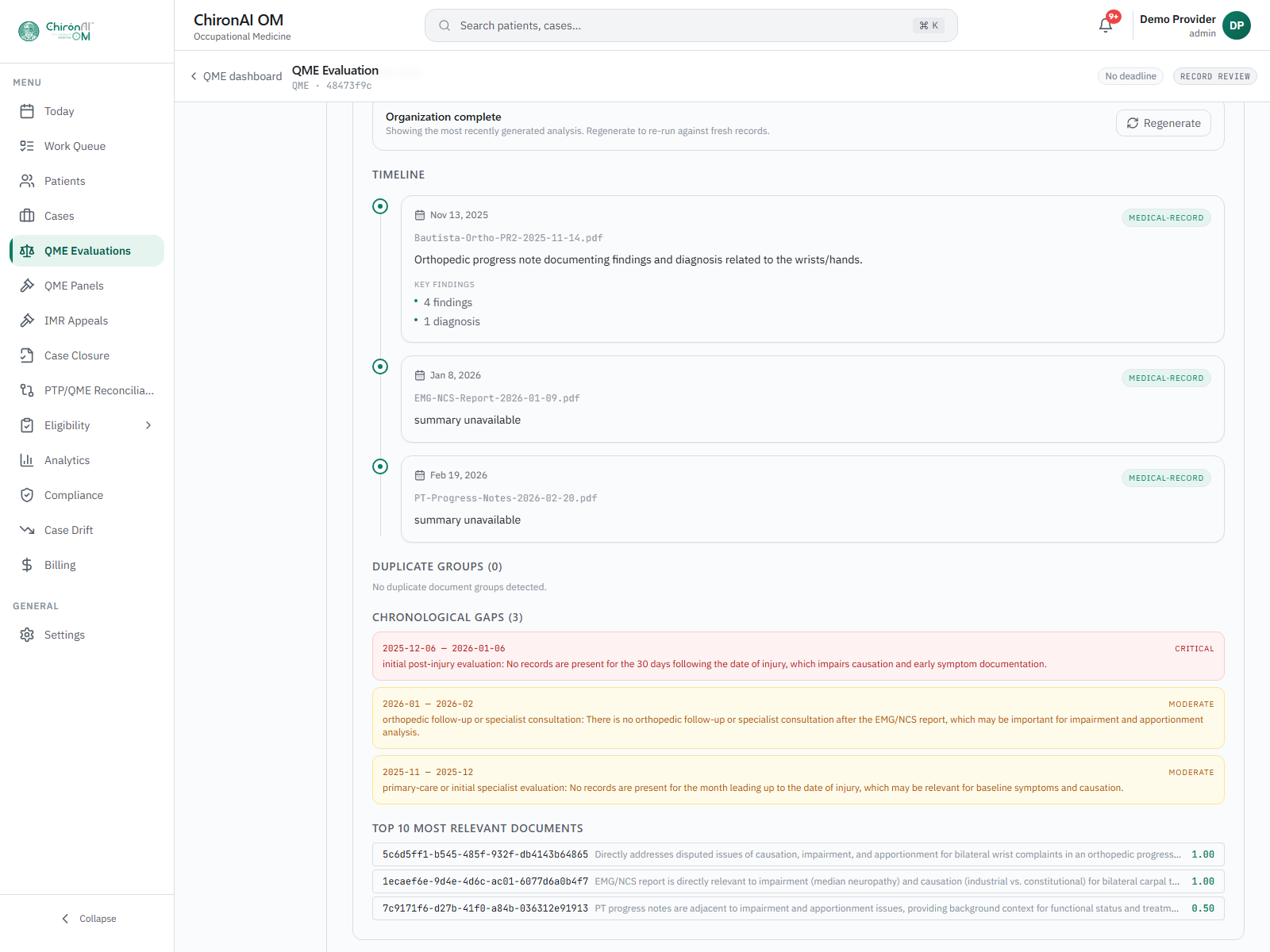
- Whole-file chronology across the box, duplicate collapse, conflicts surfaced as conflicts, an adversarial second pass over every entry.
- PTP / QME reconciliation
- Findings extracted from both sides, compared, and the disagreement drafted in a register that will not embarrass anybody at deposition.
- Legal sufficiency
- Escobedo, Brodie/Strait, Hikida, Almaraz/Guzman, applied to the apportionment finding from a registry that rejects invented authorities.
- Round Table orchestration
- The conditional convening itself, each specialist seat, and the streaming relay that makes the reasoning visible while it happens.
- Independent Medical Review
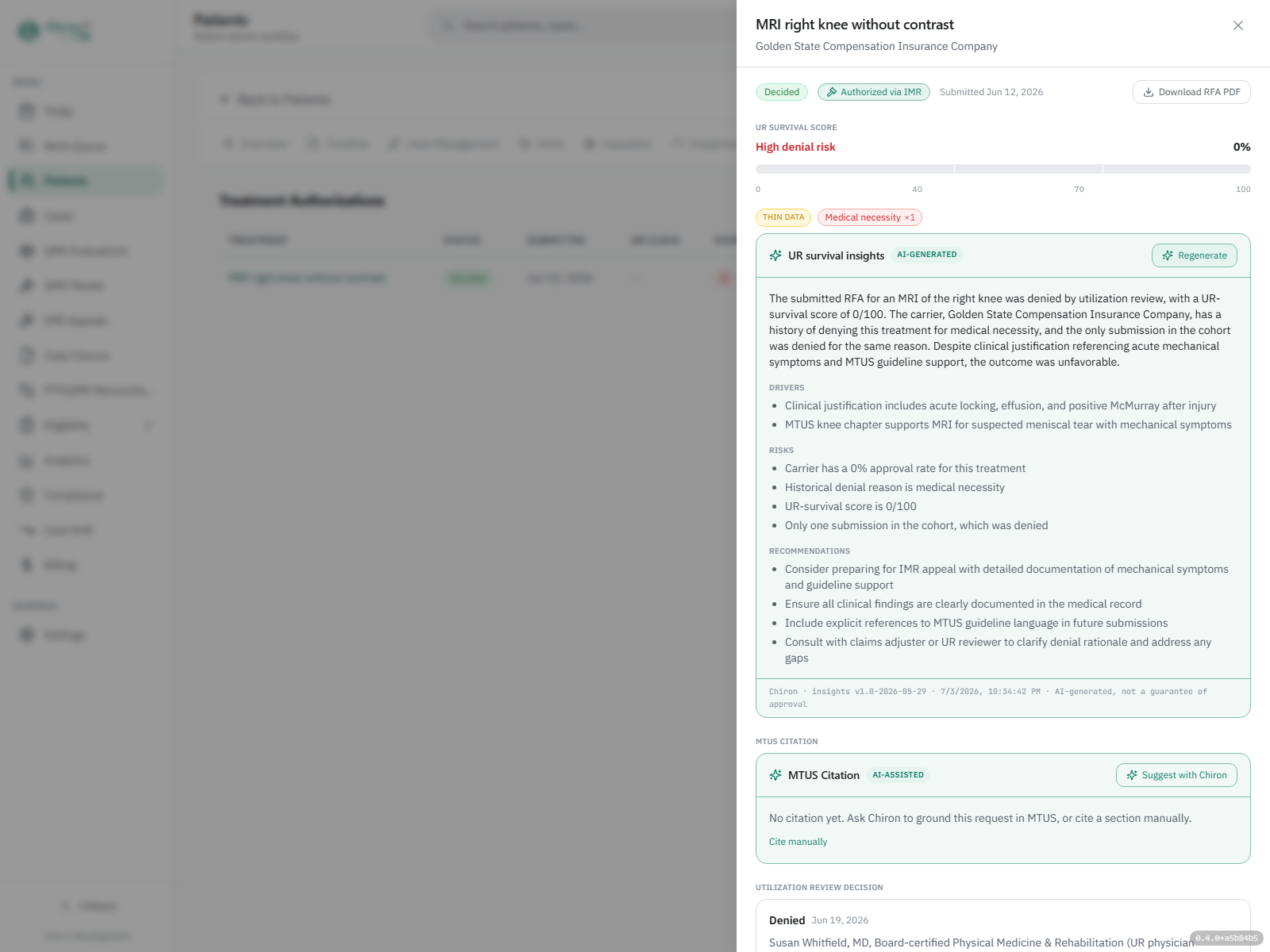
- Rationale drafting, determination classification, outcome extraction and reconciliation, exhibit collection, guardrail enforcement.
- Grounding and guardrails
- Fail-closed parsing, the AB 489 licensure rewrite, the AI-use disclosure, input sanitising, the vendor-name scrub.
- Coding and billing intelligence
- Procedure coding and evaluation-and-management scoring against the note actually written, explanation-of-review extraction, fee-schedule import.
- Ask-the-case retrieval
- The case-document semantic index, guideline retrieval, and in-product help searched in the same box as the record.
- Apportionment
- The §4663 multi-factor analysis, the narrative that explains it, and citation validation that drops references to documents never supplied.
- Document intelligence
- Intake classification and the processing pipeline that gets a scanned box into the case.
- Substrate
- Per-tenant usage accounting and speech transcription underneath the rest of it.
- Voice
- The realtime voice session.
Group sizes are deliberately absent. The registry pins the total against shrinkage, but nothing pins a per-group count, so a number printed beside a group name here would be a figure no gate could falsify. The names are checkable; the arithmetic inside them is not.