Sepsis screen
Lactate elevation alongside WBC, procalcitonin and heart rate, read together as a pattern that can accompany sepsis.
Decision support. ChironAI surfaces lab patterns to the ordering clinician for review. The clinician evaluates, orders any reflex testing, and signs the chart. ChironAI does not make a regulatory clearance claim; see Disclosures.
When the panel comes back, Chiron calls search_labs(), reads the results, and surfaces the pattern it recognizes as an attestable draft for the clinician who ordered the panel — patterns across analytes, changes since earlier results, critical values flagged, and reference ranges matched to the patient’s age, sex and pregnancy. The values themselves are extracted ground-truth: read straight from the source document, never generated. Chiron may label and interpret a value; it cannot invent a digit. The clinician decides what to do with each.
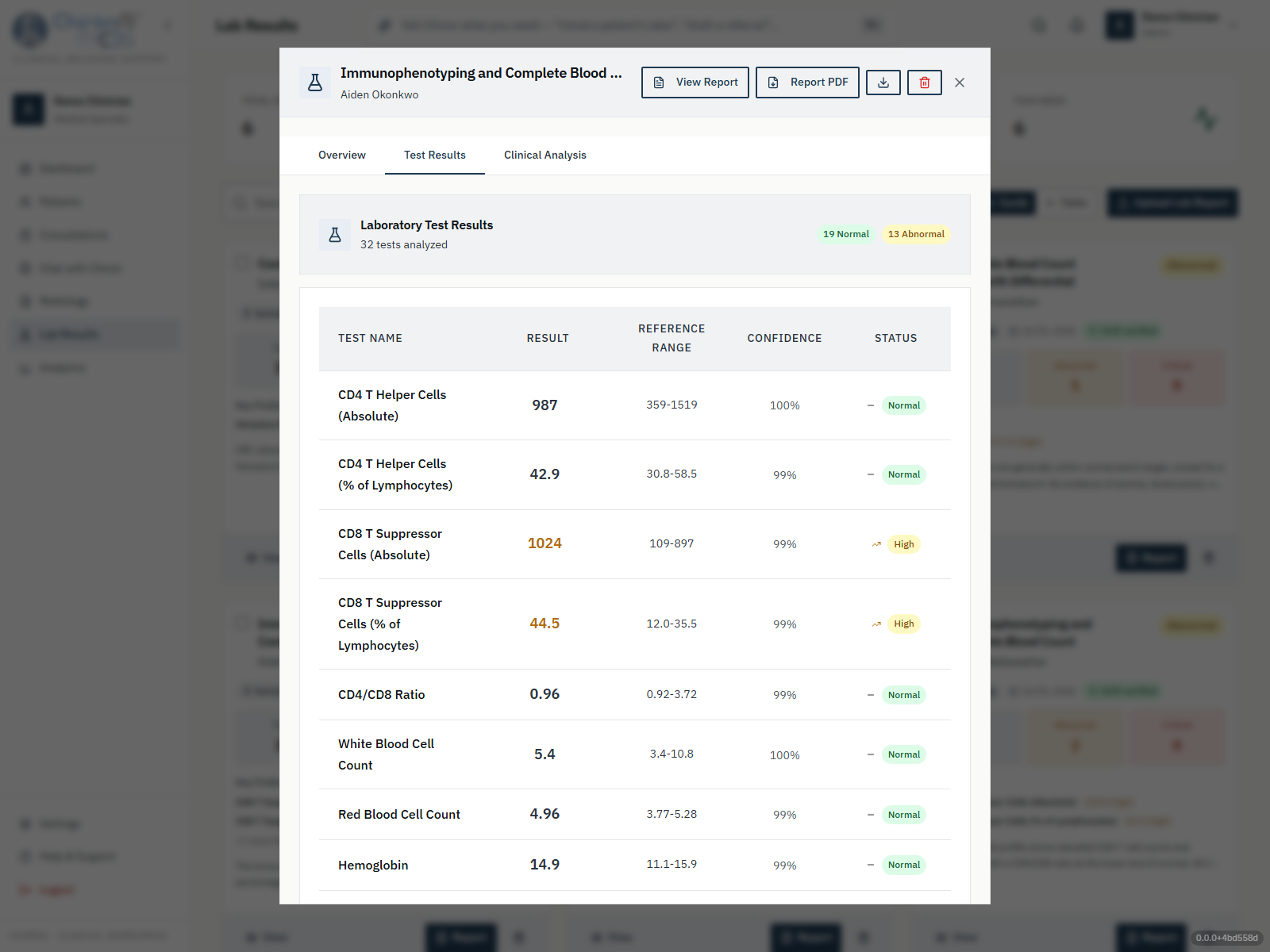
A lab value is only useful if it is the value the lab reported. In ChironAI, the numbers are extracted by Azure Document Intelligence directly from the source report — a deterministic extraction layer, separate from the reasoning layer. The reasoning engine never gets to author a result.
Chiron reasons about those values — recognizing the pattern, flagging critical values, matching the reference range to the patient’s age, sex and pregnancy — but the digit it reasons over is ground-truth. This is the difference between decision support a clinician can trust and a system that can quietly invent a potassium. It is also how the platform keeps its AB 489 posture: the AI labels and interprets; it does not fabricate the underlying fact.
Lactate elevation alongside WBC, procalcitonin and heart rate, read together as a pattern that can accompany sepsis.
Creatinine and BUN + urine output (where available) mapped to KDIGO staging.
TSH + free T4 + (free T3) recognized as subclinical hypo/hyper, overt, or sick-euthyroid.
LDL, HDL, triglycerides, non-HDL cholesterol mapped to ASCVD risk stratification.
A1c + fasting glucose + (random) mapped to ADA Standards of Care 2026.
AST, ALT, GGT, alkaline phosphatase, bilirubin, INR mapped to NAFLD, viral, drug-induced, obstructive patterns.
eGFR, creatinine, BUN, electrolytes, UACR mapped to chronic-kidney-disease staging.
WBC + differential + culture results mapped to common infectious-disease patterns.
Tumor markers (CA-125, PSA, CEA, CA 19-9, AFP) mapped to treatment response or recurrence.
Troponin, BNP/NT-proBNP, D-dimer mapped to ACS, heart-failure, and PE risk frameworks.
Examples of the patterns Chiron looks for across a panel; it is not a fixed list. Every pattern names the values it rests on, and a pattern with no evidence on the report is dropped before it reaches the clinician.
The read, in the open
panel: thyroid function
TSH, free T4, free T3 read from the report; read for patterns across the panel and for any value flagged critical.
TSH elevated with free T4 still within range — the panel reads as subclinical hypothyroidism rather than an isolated abnormal value. No critical values flagged. Confirming against the reference range for this patient before
Must review before final
Decision-support output. Clinician review and attestation required before this content is signed into the chart.
Pattern recognized — Subclinical hypothyroidism
TSH 7.1 mIU/L (elevated) with free T4 within range on this panel. Pattern consistent with subclinical hypothyroidism.
Repeat TSH + free T4 in 4–6 weeks and discuss symptoms. If symptomatic or TSH > 10 mIU/L, consider levothyroxine.
TSH · this panel
extracted · no critical values flagged
Must review before final
Decision-support output. Clinician review and attestation required before this content is signed into the chart.
Pattern recognized — Early sepsis screen positive
WBC 14.2 (elevated), lactate 2.6 mmol/L (above the 2.0 threshold), procalcitonin 0.9 ng/mL, HR 112. Read together, a pattern that can accompany sepsis.
For the clinician to evaluate urgently. The clinician decides next steps.
Lactate · this panel
extracted · critical value flagged
Reference ranges shift across demographic context — age, sex, pregnancy status, specialty context. A creatinine of 0.4 mg/dL is normal for a 3-year-old and would falsely trigger an AKI alert if compared to adult reference ranges.
ChironAI’s labs posture adjusts reference ranges for the demographic context before pattern recognition runs. Pediatric, geriatric, pregnancy, and specialty- specific reference ranges live in the same vocabulary the lab itself uses, and the system matches them.
Tell us the workflow you want to see and who needs to be in the room. A member of our clinical and engineering team replies within two business days to arrange it — a real person, not a sequence.
Talk to our team →What happens after you send it
Prefer to talk now? +1 (949) 200-8668, or email hello@mindhyve.ai.